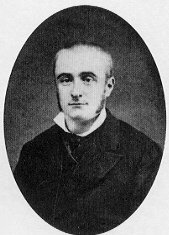
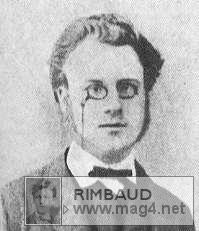
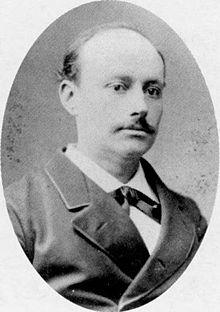
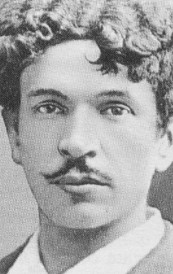
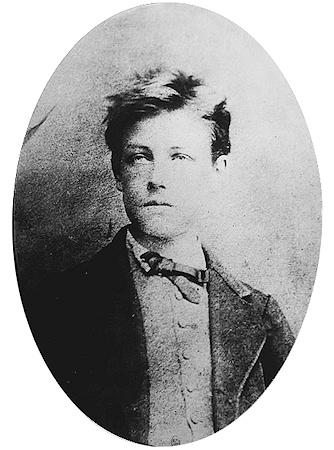
Arthur Rimbaud in September-October 1871 Photograph by Etienne Carjat |
"The Child of Anger"
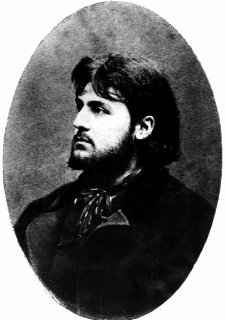
"The Infernal Husband" "The Man with Soles of Wind" ...................... "The man was tall, well-built, almost athletic, with the perfectly oval face of an angel in exile, with untidy light brown hair and eyes of a disturbing pale blue" Paul Verlaine: The Accursed Poets
...................... |
|
Jean Nicolas Arthur Rimbaud was born in Charleville, in the Ardennes, on 20th October, 1854. His father, Frédéric Rimbaud, an infantry Captain, and his mother Vitalie Cuif, who came from a farming family in the Ardennes, married in 1853. Arthur had an elder brother, Frédéric, and two sisters, Vitalie and Isabelle born, respectively, in 1858 and in 1860. Some months after Isabelle's birth, their father joined his regiment in Grenoble and never returned home. He left his wife and children to fend for themselves. After his time in the army, he chose to retire to Dijon. Deeply hurt, his wife no longer talked about him. She became known as "Widow Rimbaud". The children were very strictly educated. Their mother was a strict catholic. She feared that they would follow the bad example of their father, and of their maternal uncles Cuif who were alcoholics. The two boys entered the Rossat Institute and later, in 1865, Charleville College, where Arthur met Ernest Delahaye, who would remain his most faithful friend.
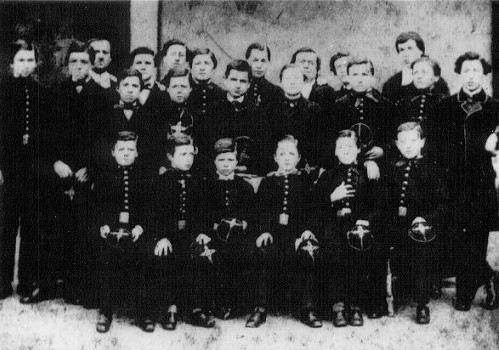
Arthur Rimbaud at the age of 10, among the students of the Rossat Institute
(The 3rd boy seated from the left) As a brilliant student and a model pupil, Arthur won many prizes, especially in rhetoric. When he was thirteen years old, he secretly sent a tribute to the Imperial Prince who had just taken his first communion. He wrote his first lines in Latin. In 1869, he won the first prize in an academic contest for Ver Erat, The Angel and The Child, and Jugurtha. One of his professors from his third year, Mr. Pérette said about him: "Intelligent, as much as you want, but he has eyes and a smile which I do not like. He will come to a bad end. In any case, nothing banal will germinate in that head. He will be the genius for good or evil!" In January 1870, his first lines were published in The Review: The Orphans' New Year Gifts. Then a new teacher of rhetoric, Georges Izambard, himself a poet, arrived from Paris. He became fond of Arthur and made him happy by letting him use his personal library. However, Mrs Rimbaud strongly disapproved for she thought that some of the books would corrupt her son. On 24th May, 1870, hoping to be published in the contemporary Parnassus, Arthur sent his poems Sensation, Ophelia and Credo in Unam (first Sun and Flesh version) to Theodore Banville. Then the following year, he sent What we say to the poet about flowers. He was not discouraged by these failures. In 1871, France waged war against Prussia. Everything was in chaos. Izambard left for Douai, allowing Arthur to go on to access to his library. But Arthur paced about and became really bored: "My city is exceptionally idiotic among all the small provincial towns" he wrote to Izambard." |
|
On 29th August, he ran away to Paris for the first time via Charleroi. His ticket was not valid for the whole journey and he was imprisoned in Mazas. Following the intervention of Izambard, he was released and went to Douai to spend two weeks with Izambard's elderly aunts, the Misses Gindre. He was not greeted warmly on his return. On 7th October, Arthur ran away again to Belgium (Charleroi), then to Brussels, before returning to the Misses Gindre's house in Douai. There, he wrote up his poems and sent them to Paul Demeny, a young poet introduced to him by Yzambard. On 1st November, Rimbaud's mother asked the Police to bring him back home. The college buildings were requisitioned as a hospital and the
school was closed. So Arthur spent a lot of time in Charleville's library. When the Commune broke out in Paris on 18th March, he sympathised with the insurrectionists. He expressed his feelings in Parisian Song of War, Jeanne-Marie's Hands, Paris is Repeopled. He became rebellious and anarchist and violent. He started to drink and enjoyed himself to behave scandalously. He gave in to the "disorder of all the senses". |
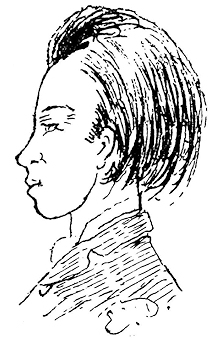
Arthur in 1871. Drawing by Delahaye |
|
He explained his behaviour and feelings to his friends Izambard and Demeny in two letters known as "of the Visionary". He asked Demeny to burn the poems that he previously sent to him, judging them outmoded. Fortunately, his friend did not do it. At the end of August, he wrote to the poet Paul Verlaine and sent him some poems. Charmed, Verlaine invited him to Paris: "Come, dear great soul, you are called, you are awaited". In Mid-September, Rimbaud went to Paris with his poem, The Drunken Boat. Verlaine was married to the rich girl of a middle-class man, Mathilde Mauté de Fleurville, and was living in his parents-in-law's home. The arrival of Arthur caused a scandal in the family, because of his rude, untidy and insulting behaviour. He was so undesirable, that he was finally lodged with different friends of Verlaine. Verlaine subsequently returned to drinking and spent most of his time hanging about with Rimbaud. They kept company with the Zutist Circle of poets, which was created by Charles Cros, and used to met at Hotel Des Etrangers, on the boulevard Saint-Michel. They contributed to the collective Album of the group. Ernest Cabaner, the barman, was teaching piano to Rimbaud with the method of musical chromaticism, colouring notes and giving them the sound of a vowel (It seems to be the real source of Rimbaud's inspiration for the poem Vowels). Arthur was his assistant in the club for some months, and was allowed to sleep in the room. But with his sullen and aggressive attitude, and being rude to everybody, Arthur quickly became very unpopular. Verlaine was supporting him. Their love affair was a scandal. They led a dissolute life and haunted Cafes, getting drunk on Absinthe. A victim of marital violence, Mathilde ended up fleeing with her son. In March, Verlaine promised to break off his relationship with Rimbaud, who had returned to Charleville, so Mathilde agreed to go back home. Back to Paris in May, Arthur was so disappointed by his Parisian experience and by Verlaine who preferred his life as a good father, that he decided to travel, with or without him. He contacted Verlaine and succeeded in persuading him to go with him. Together they left for Brussels in July 1872. Mathilde wanted to bring her husband back home, so she joined them with her mother. But Verlaine preferred to follow Rimbaud and abandoned her at the station, near the frontier. She went back to Paris and asked for a legal separation. |
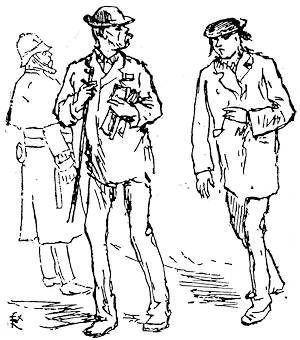
Verlaine and Rimbaud in London (Sept-Dec. 1872) Drawing by Felix Régamey |
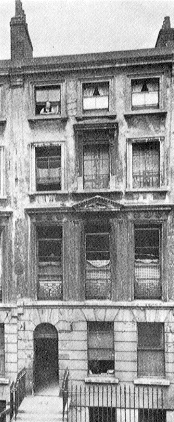
At the beginning of September, they went from Ostend to London. They saw the sea for the first time. On their arrival, they contacted the exile Communards, like Eugène Vermersh and Félix Regamey. They were helped to settle near Soho, 34 Howland Street. Being enthusiastic about the town, Rimbaud composed part of the Illuminations and Verlaine wrote the "Romances sans Paroles". But Verlaine was harassed by the papers resulting of his wife's request for a
legal separation. She could cite his fits of violence due to alcohol and his abnormal behaviour in Brussels against him. He lost heart
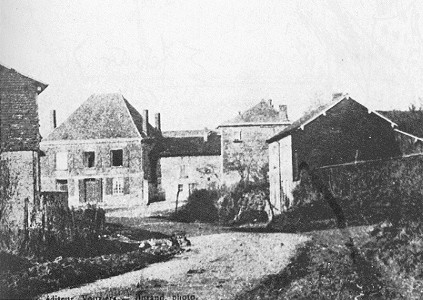
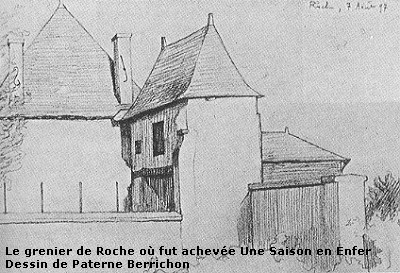
and lamented, overwhelmed with remorse. Following his mother's advice, Rimbaud went back to Charleville in December. Life went on as before with walks, reading and studies. On 4th April, they left London. Verlaine went to Namur, always obsessed by the idea of being reconciled with his wife. But she refused all contact. All alone, Arthur returned to Roche on April 11th and started to write a Pagan Book, or Negro Book, which became a Season in Hell. |
|
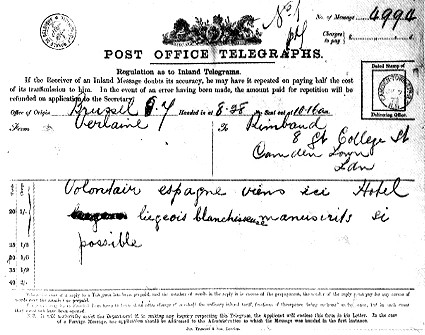
At the beginning of July, he agreed to go back to London with Verlaine, via Liège and Anvers. They settled in 8 Great College street, Camden Town. They improved their English and gave French lessons. Their strange love affair begun to be known in the Communard circle of London, which expelled them. It was mentioned in the reports of the police informers, who infiltrated the group. Verlaine felt that his reputation was lost and began to see that he would lose his case against his wife if the rumour was heard in Paris. He started to drink again. Arthur was more and more unbearable. They began to fight more and more often with fists, but also with knifes. Following a violent argument, Verlaine left Rimbaud and took refuge in Brussels, still hoping that her wife would come and that they would be reconciled. Very emotional, he spoke about suicide in his letters. His mother joined him and he sent a telegram for Arthur to come too. On 10th July, understanding that Rimbaud absolutely wanted to go back to Paris, Verlaine fired two shots from a revolver at him. One of them hits him in the wrist. After being treated in the Saint-Jean hospital, Arthur made his way towards the station. As Verlaine was threatening him again, he took fright and called a policeman. Verlaine was taken to the police station and the day after, he was transferred to the prison of Petites-Carmes. He was subjected to a medico-legal examination which concluded that he had homosexual habits. On August 8th, he was sentenced to two years of imprisonment by Brussels magistrates' court for assaults and grievous bodily harm, and got a 200F fine, in spite of Rimbaud's declaration in his favour. Arthur was hospitalised so the bullet could be removed from his wrist.
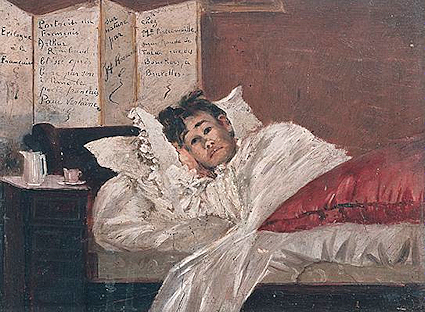
Rimbaud wounded, painting by Jef Rosman. Collection Rimbaud's Museum, Charleville.
Behind Rimbaud, these words are written: On 20th July, after having signed an act of renunciation of his complaint the day before, Arthur was in despair and went back to Roche. He locked himself up in his loft to finish a Season in Hell. In August, he brought the manuscript to a printer in Brussels. On 22nd October, being unable to pay for the printer, he took some copies, gave them to rare friends, and abandoned the edition of his book. But he only found hostility: everybody reproached him about the decline of Paul. He left one signed specimen for Verlaine in prison. In March 1874, he went back to London with Germain Nouveau, another poet who helped him to write up the Illuminations. They settled in 178 Stamford Street and gave French lessons. Nouveau went back to Paris in June, probably to escape Arthur's bad reputation which could damage his promising young career. Depressed, Arthur wrote a letter to his family and in July, he received a visit from his mother and sister Vitalie. On 31st July, he left London for a job in Scarborough. He went back to Charleville at the end of December. Until 1879, he wandered on foot mostly, throughout Europe. Page 1 | Page 2 |