
I
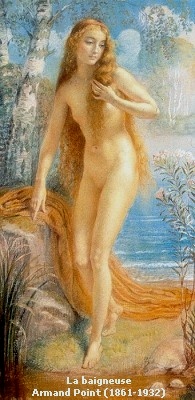
That idol, black eyes and yellow mop, without parents or court, nobler than Mexican and Flemish fables; his domain, insolent azure and verdure, runs over beaches called by the shipless waves, names ferociously Greek, Slav, Celt.
At the border of the forest - dream flowers tinkle, flash, and flare, - the girl with orange lips, knees crossed in the clear flood that gushes from the fields, nakedness shaded, traversed, dressed by rainbow, flora, sea.
Ladies who stroll on terraces adjacent to the sea; baby girls and giantesses, superb blacks in the verdigris moss, jewels upright on the rich ground of groves and little thawed gardens, - young mothers and big sisters with eyes full of pilgrimages, sultanas, princesses tyrannical of costume and carriage, little foreign misses and young ladies gently unhappy.
What boredom, the hour of the "dear body" and "dear heart."
II
It is she, the little girl, dead behind the rosebushes.
- The young mamma, deceased, comes down the stoop. - The cousin's carriage creaks on the sand. - The little brother (he is in India!) there, before the western sky in the meadow of pinks. The old men who have been buried upright in the rampart overgrown with gillyflowers.
Swarms of golden leaves surround the general's house. They are in the south. - You follow the red road to reach the empty inn. The chateau is for sale; the shutters are coming off. The priest must have taken away the key of the church. Around the park the keepers' cottages are uninhabited. The enclosures are so high that nothing can be seen but the rustling tree tops. Besides, there is nothing to be seen within.
The meadows go up to the hamlets without anvils or cocks. The sluice gate is open. O the Calvaries and the windmills of the desert, the islands and the haystacks!
Magic flowers droned. The slopes cradled him. Beasts of a fabulous elegance moved about. The clouds gathered over the high sea, formed of an eternity of hot tears.
III
In the woods there is a bird; his song stops you and makes you blush.
There is a clock that never strikes.
There is a hollow with a nest of white beasts.
There is a cathedral that goes down and a lake that goes up.
There is a little carriage abandoned in the copse or that goes running down the road beribboned.
There is a troupe of little actors in costume, glimpsed on the road through the border of the woods.
And then, when you are hungry and thirsty, there is someone who drives you away.
IV
I am the saint at prayer on the terrace like the peaceful beasts that graze down to the sea of Palestine.
I am the scholar of the dark armchair. Branches and rain hurl themselves at the windows of my library.
I am the pedestrian of the highroad by way of the dwarf woods; the roar of the sluices drowns my steps. I can see for a long time the melancholy wash of the setting sun.
I might well be the child abandoned on the jetty on its way to the high seas, the little farm boy following the lane, its forehead touching the sky.
The paths are rough. The hillocks are covered with broom. The air is motionless. How far away are the birds and the springs! It can only be the end of the world ahead.
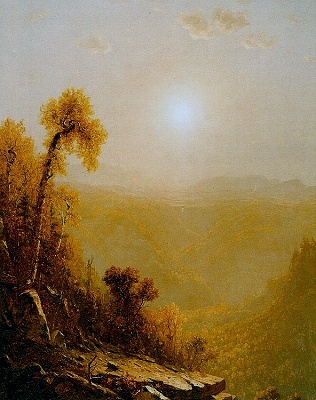
October in the Catskills
Sanford Robinson Gifford, 1880 (1823-1880)
V
Let them rent me this whitewashed tomb, at last, with cement lines in relief, - far down under ground.
I lean my elbows on the table, the lamp shines brightly on these newspapers I am fool enough to read again, these stupid books.
An enormous distance above my subterranean parlor, houses take root, fogs gather. The mud is red or black. Monstrous city, night without end!
Less high are the sewers. At the sides, nothing but the thickness of the globe. Chasms of azure, wells of fire perhaps. Perhaps it is on these levels that moons and comets meet, fables and seas.
In hours of bitterness, I imagine balls of sapphire, of metal. I am master of silence. Why should the semblance of an opening pale under one corner of the vault?

